Map your personal values

Identify what actually drives you, then check how you are living it.

No card required · 40 research-backed cards · Week 1 free

Why values come first

Ever hit every goal and still felt drained? That is not a workload problem. That is a values problem.

When your daily work clashes with what you actually care about, your body sends signals: the flat battery after an easy day, the snap over something small, the win that should feel great but doesn't.

Values are the roots of your tree. Strengths are the trunk. Goals are the fruit. This exercise starts with the roots.

Watercolour illustration of a tree with roots, trunk, and fruit, standing for values, strengths, and goals.

Your values are your roots. They ground you.

Why these 40 values?

  • Forces real trade-offs. A short pick-two list skips the hard part. Forty cards means you have to choose between values that both matter to you. That is how you find out what you actually protect.
  • Plain language, not poster language. Every card says what the value looks like in practice, not what it sounds like on a lobby wall.
  • Built on Schwartz's cross-cultural research. Four dimensions that show how your values support or pull against each other, so the results stay useful long after the sort is done.
  • Finishable. Small enough to complete in about 30 minutes. Big enough that you cannot cheat it.
  • Curiosity

    To keep asking questions and finding out how things work.

  • Creativity

    To make new things and try ideas nobody else has.

  • Ambition

    To aim high and keep working toward a bigger future.

  • Craftsmanship

    To do every job properly and take pride in the finish.

  • Security

    To keep the bills paid, the door locked and tomorrow safe.

  • Harmony

    To keep things smooth and friendly with the people around me.

  • Compassion

    To notice when anyone is hurting and step in with care.

  • Fairness

    To make sure everyone gets a fair go and a fair share.

View all 40 cards

Openness to change

  • Adventure

    To go looking for new places and bold experiences.

  • Challenge

    To take on hard things that stretch what I can do.

  • Creativity

    To make new things and try ideas nobody else has.

  • Curiosity

    To keep asking questions and finding out how things work.

  • Freedom

    To live and work on my own terms, not someone else's.

  • Independence

    To stand on my own two feet and sort things out myself.

  • Learning

    To keep growing my skills and knowledge all my life.

  • Spontaneity

    To act on the spur of the moment and follow the day.

  • Variety

    To keep change in my days so life never feels stale.

Self-enhancement

  • Ambition

    To aim high and keep working toward a bigger future.

  • Comfort

    To make space for rest, ease and simple pleasures.

  • Craftsmanship

    To do every job properly and take pride in the finish.

  • Fun

    To make room for play and enjoy myself along the way.

  • Humour

    To see the funny side of life and share a laugh often.

  • Leadership

    To step up, take charge and bring others along with me.

  • Recognition

    To have my efforts noticed and my name respected.

  • Success

    To set clear goals and reach them, again and again.

  • Wealth

    To build money and resources that give me choices.

Conservation

  • Duty

    To honour my obligations and see every task through.

  • Faith

    To live by my beliefs and let them steady me in hard times.

  • Harmony

    To keep things smooth and friendly with the people around me.

  • Health

    To care for my body and energy so I can live fully.

  • Order

    To keep my world planned, tidy and running smoothly.

  • Peace

    To help build a calm, safe world for everyone.

  • Respect

    To treat people with courtesy and good manners.

  • Security

    To keep the bills paid, the door locked and tomorrow safe.

  • Stability

    To build a steady life with routines I can trust.

  • Tradition

    To keep the customs and stories of my culture alive.

Self-transcendence

  • Acceptance

    To let people be who they are, without trying to change them.

  • Belonging

    To be part of a group where I am known and welcome.

  • Compassion

    To notice when anyone is hurting and step in with care.

  • Fairness

    To make sure everyone gets a fair go and a fair share.

  • Family

    To put the people closest to me at the centre of my life.

  • Honesty

    To tell the truth and speak plainly, even when it is hard.

  • Humility

    To do good work quietly, without talking myself up.

  • Kindness

    To be warm and helpful to the people I meet each day.

  • Loyalty

    To stand by my people in good times and rough ones.

  • Nature

    To spend time outdoors and care for the natural world.

  • Open-mindedness

    To listen to different views and let them teach me.

  • Reliability

    To do what I said I would do, every single time.

How the sort works

  1. Step 1. Scan the deck

    You see all 40 cards. Make a first-pass yes pile of anything that pulls you. Do not think too hard. If a word is missing, add your own.

  2. Step 2. Cut to 10, then rank to 5

    This is where it gets real. If two feel equal, ask: if I could only keep one this week, which? Cut the yes pile to 10, then highlight your top 5 in order. The hard choices are the point.

  3. Step 3. Test your receipts

    For each of your top 5, check it against last month. Where did your time, energy, and money actually go? If a value only sounds good but you would not protect it under pressure, it is a poster, not a lived value. Swap it.

  4. Step 4. See your map

    Your top 5 lands on a values map showing where you sit across four dimensions. You can see which quadrants are loaded and where you have blind spots. In the app, you also get an alignment audit: rate each value as fed, mixed, or starved, and walk away with one concrete action.

See your values on a map

The StrengthsWire app does more than rank words. After the sort, your top 5 land on a map across four quadrants. You can see which drives are loaded, where they pull against each other, and how that pattern shows up in you and in other people.

That is how you harness values: not as a poster, as a way to read yourself and the people around you. Do it online, keep the result on your phone, and come back to it when a decision gets hard.

Try the map in the app

What the exercise gives you

  • Rank what matters

    Forty cards, ruthlessly narrowed to your top 5. Not a list where everything sounds nice. Not what your boss would pick. What you actually protect when it costs you something.

  • See where you are aligned

    Rate each of your top 5 as fed or starved this month. The alignment audit shows you the gap between what you value and how you are living. That gap is where burnout lives.

  • Do something about it

    Self-awareness without action is just rumination. You write one concrete commitment: what you will do, by when, and how you will check that you did it.

Take it offline

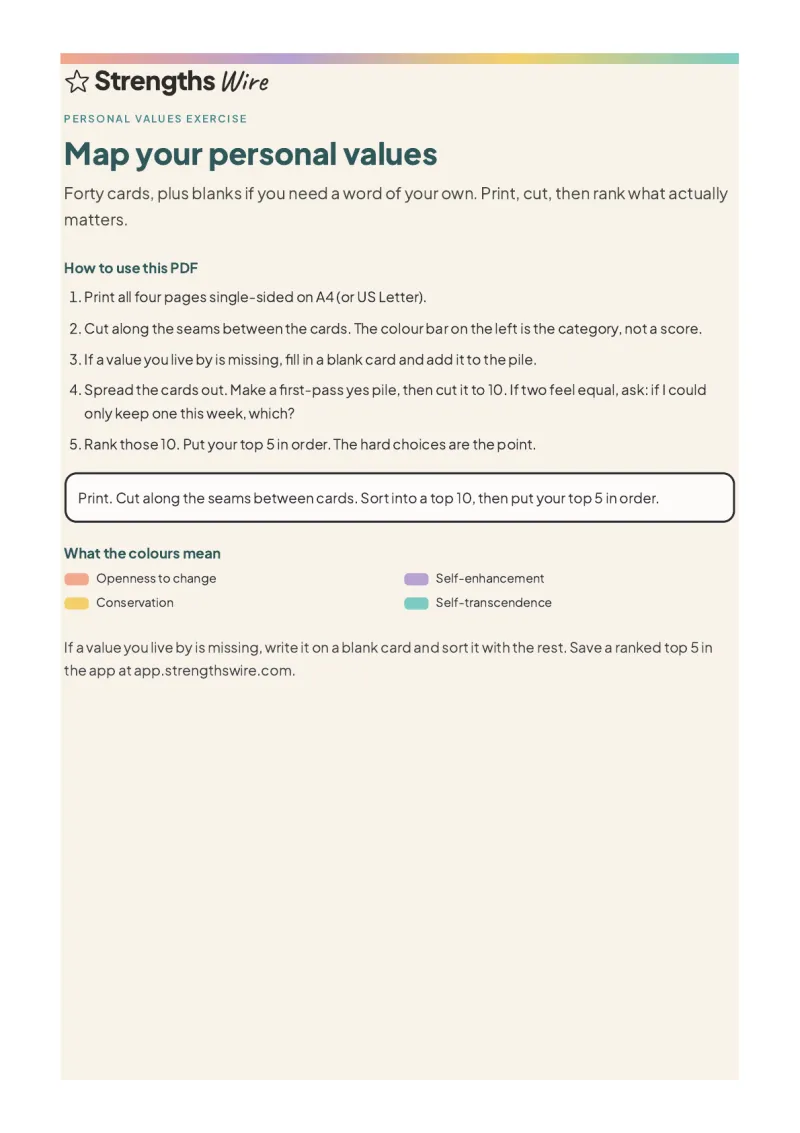
Download the personal values exercise as a PDF. Print the four pages, cut out the 40 cards plus blanks for your own words, then sort to a top 10 and rank a top 5 in order.

Download the PDF
Page 1 of the PDF: instructions for printing, cutting, and ranking 40 values cards.4-page PDF

Questions

What is a values card sort?

A values card sort is an exercise where you start with a large set of values (ours has 40) and narrow them down through forced choices until you have a ranked top 5. The forced scarcity is what makes it work. Ticking "all of the above" teaches nothing. Having to choose between two values that both matter to you reveals which ones you actually live by.

How do I find my core values?

Look at the receipts, not the poster. Your lived values show up in where your time, energy, and money go during a crisis, not in the adjectives on your LinkedIn profile. The card sort is designed to surface those lived values by forcing hard trade-offs rather than letting you pick everything that sounds admirable.

What are examples of personal values?

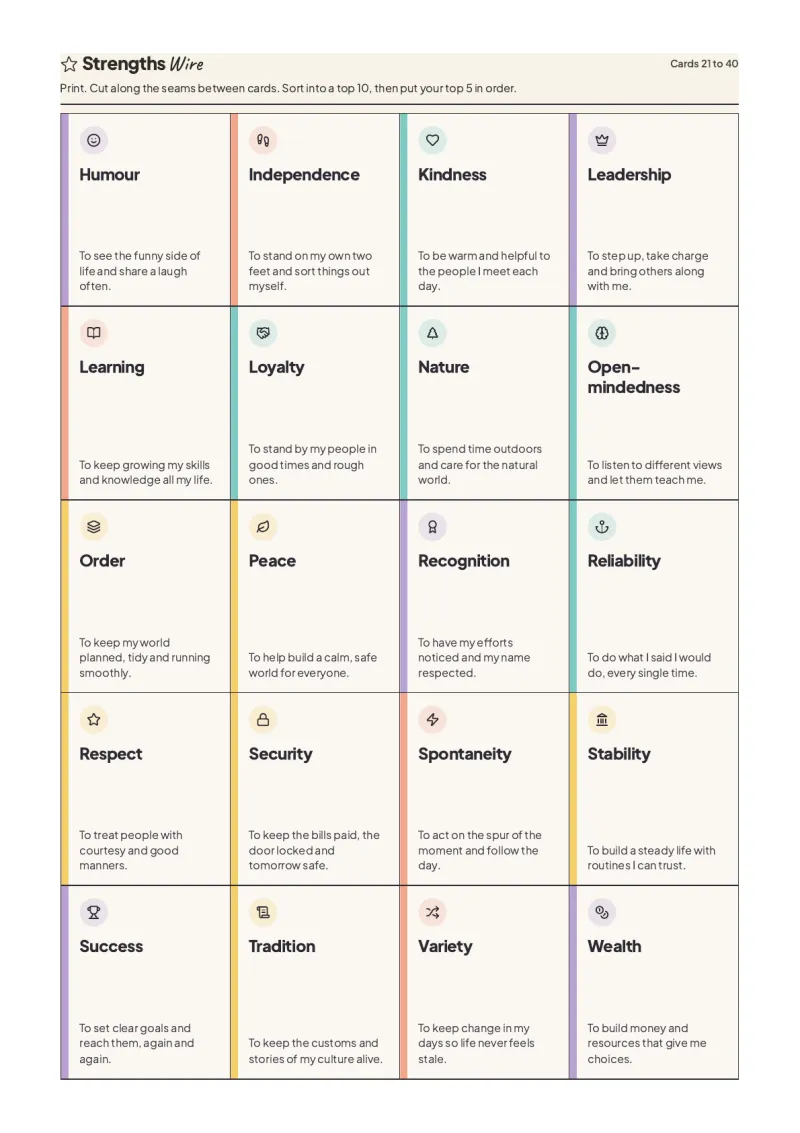
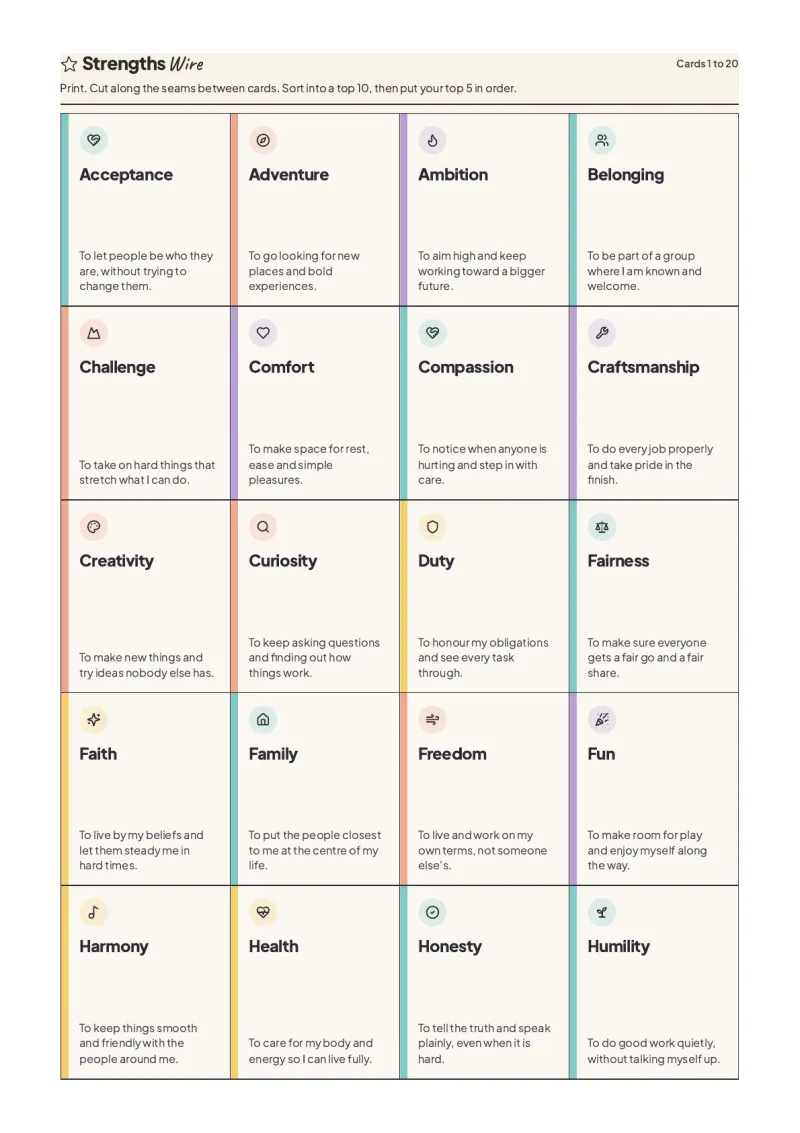
Our deck includes 40 values like Curiosity, Creativity, Craftsmanship, Security, Compassion, Fairness, Freedom, and Ambition. Every card has a plain-language sentence explaining what it means in practice. You can view all 40 on this page or in the PDF.

Is there a PDF I can download?

Yes. The personal values exercise PDF has StrengthsWire instructions on every page, 40 cut-out cards (20 per sheet), and a full page of blank cards for words of your own. Print, cut, then sort to a top 10 and a top 5 in order. Direct download, no email required.

Do I need to have done CliftonStrengths first?

No. Values and strengths are different layers. Values are what you care about. Strengths are how you naturally think and work. This exercise covers values only. Strengths come later in the program if you want to keep going, but the values sort is complete on its own.

Can I skip straight to the card sort in the StrengthsWire app?

Yes. The StrengthsWire app is where the live sort lives. Week 1 has seven lessons. The card sort is in Discover Your Values. You can jump straight into the app from this page, or start from the first lesson to build context. Either way works.

How long does the exercise take?

The card sort itself takes about 20 minutes. If you do all of Week 1, including the lessons on misalignment, your lizard brain, and the alignment audit, that is about 86 minutes across seven lessons. You can dip in and out.

How does this compare to other values exercises?

Forty is the size that makes the sort work. It is large enough that you cannot pick everything, so the trade-offs (the point of the process) actually happen. It maps to Schwartz's four higher-order dimensions, which is what lets you read a pattern after the sort, not just a list of favourite words. And it is small enough to do in about 30 minutes on a phone, so you always have the deck with you for later reflection. Brené Brown's exercise uses a shorter list and asks you to pick two. ACT uses a values bullseye across life domains. Both are well-regarded. Ours is a forced-rank sort in the StrengthsWire app, then a map and an alignment audit.

Looking for a Gallup-certified strengths coach after you map your values? See strengths coaching.

Do it in the StrengthsWire app

No download. No credit card. Week 1 is free: all seven lessons, from the card sort to the alignment audit. Open it on your phone and keep your values with you.