1
Curiosity
To keep asking questions and finding out how things work.
Burnout
Is it you, or is it the job? Usually it’s the fit between the two. Find out where the gap is, and what to do about it.
No credit card · 5–10 min lessons · On your phone
StrengthsWire is a five-week course that brings together the best of capability training and self-awareness, built on thirty years of coaching, consulting and leading teams. Week 1 is the values module, and it’s free.

Burnout comes from chronic stress at work (Burnout is a work problem: The WHO classifies burn-out as an occupational phenomenon, the result of chronic workplace stress that hasn’t been successfully managed. It is not classed as a medical condition or a personal weakness. Source: World Health Organization (2019) Burn-out an “occupational phenomenon”: International Classification of Diseases.), not from a weakness in you. It shows up in three ways (The three dimensions of burnout: Burnout is measured on three dimensions: exhaustion that rest doesn’t shift, cynicism (a growing distance from the work) and reduced efficacy (doubting a competence you objectively have). Cynicism is not laziness; it’s a defensive posture the mind adopts to stop spending emotional energy that brings no return. Source: Maslach, C. and Leiter, M.P. (2016) ‘Understanding the burnout experience: recent research and its implications for psychiatry’, World Psychiatry, 15(2), pp. 103–111.), and they’ll probably sound familiar.
You sleep in on Saturday and still wake up tired. The fatigue sits deeper than a late night, and a weekend doesn’t touch it.
You used to have opinions in meetings. Now you do what’s asked and save your energy. That distance is a defence, and it grows the longer you need it.
The work hasn’t got harder. Some days it’s never been easier, and still everything takes more out of you. You’ve started wondering if you were ever any good at this.
Tired and burnt out are different problems. Rest fixes tired. Burnout comes back twenty minutes after you reopen the laptop, because the exhaustion was never about the hours. It comes from what fills them.
Hard workers run on one of two engines (Pushed vs pulled (workaholism vs engagement): Research on heavy workers distinguishes two engines behind the same long hours. Engaged workers are pulled toward work that matters to them and thrive on big loads. Workaholics are pushed through the same hours by compulsion, guilt and the inability to disengage, and only the pushed burn out. The hours aren’t the variable; the engine is. Source: Schaufeli, W.B., Taris, T.W. and van Rhenen, W. (2008) ‘Workaholism, burnout, and work engagement: three of a kind or three different kinds of employee well-being?’, Applied Psychology, 57(2), pp. 173–203.). Some are pulled toward their work by purpose and meaning. Others are pushed through it by guilt and obligation. Both put in long hours, and both can burn out, even in a job that matters. But the pushed burn out faster, because their work hollows them out instead of filling them up. That’s why the same job can energise one person and drain another.
And it isn’t always too much work. Sometimes the purpose is there but the progress isn’t: you care about the work, you keep pushing, and nothing moves. Or the job has stopped stretching you, with nothing left to figure out and nowhere obvious to go next. People who thrive on a challenge can go flat in a job that’s stopped stretching them (What boredom at work costs: Boredom at work is linked to distress, low mood and counterproductive behaviour. Employees who reshaped their own jobs to add challenge (job crafting) reported less boredom. Source: van Hooff, M.L.M. and van Hooft, E.A.J. (2014) ‘Boredom at work: proximal and distal consequences of affective work-related boredom’, Journal of Occupational Health Psychology, 19(3), pp. 348–359.), and from the inside it feels a lot like burnout.
Nadia comes back from Queensland
Nadia spends two weeks on the Sunshine Coast and feels like herself again. On her first morning back she opens her laptop, reads the first three emails, and feels every bit of the rest drain away before stand-up. Nothing about the fortnight was wrong. Nothing about the job had changed. That was the problem.
Burnout doesn’t hit all at once. It leaks. When your work stops lining up with what drives you, the gap drains energy from three places.
You value doing things properly and you’re told to ship it rough. You value people and you spend your days on reports nobody reads. Working against your values costs more (Self-determination theory: People do their best, and stay well, when their work meets needs for autonomy, competence and connection. Work that cuts against what matters to you drains more than hard work does. Source: Ryan, R.M. and Deci, E.L. (2000) ‘Self-determination theory and the facilitation of intrinsic motivation, social development, and well-being’, American Psychologist, 55(1), pp. 68–78.) than working hard ever does.
You could do the job in your sleep. No new problems, no next level, nothing that makes you think hard. If you’re wired to learn or to build, coasting wears you down in its own way, because feeling capable needs something to be capable at (Self-determination theory: People do their best, and stay well, when their work meets needs for autonomy, competence and connection. Work that cuts against what matters to you drains more than hard work does. Source: Ryan, R.M. and Deci, E.L. (2000) ‘Self-determination theory and the facilitation of intrinsic motivation, social development, and well-being’, American Psychologist, 55(1), pp. 68–78.).
Approvals for routine calls. Status updates about status updates. When your bandwidth goes on proving you’re working, nothing is left for the work itself (Self-determination theory: People do their best, and stay well, when their work meets needs for autonomy, competence and connection. Work that cuts against what matters to you drains more than hard work does. Source: Ryan, R.M. and Deci, E.L. (2000) ‘Self-determination theory and the facilitation of intrinsic motivation, social development, and well-being’, American Psychologist, 55(1), pp. 68–78.).
These never show up on a timesheet. They show up at 4pm on a Sunday.
New tools every month, more content in a day than you could read in a year, and a growing share of your working hours spent talking to AI instead of people. AI doesn’t cause the misalignment, but it amplifies it. It helps you produce more, faster (AI and the overloaded workday: Microsoft’s Work Trend Index on how AI is changing work. Many people feel overloaded by the pace and volume of work, and AI’s promise is in freeing time for the work that matters most. Source: Microsoft (2023) Will AI fix work? Work Trend Index.), of work that already wasn’t yours. It can also take the stretch out of a job. When the tool does the thinking you used to enjoy and you’re left checking its work, the part that kept you sharp goes with it.
When the tools can produce almost anything, the question is no longer how to do more. It’s which work is worth your energy. Answering that means knowing what you care about, and most of us have never stopped long enough to work it out.

Burnout isn’t random. It follows a pattern: certain values get fed by your work and others get starved, and the gap shows up as exhaustion, cynicism, or a slow loss of purpose. Values like Challenge, Learning and Curiosity count too, and a job you’ve outgrown can starve them without you noticing.
The alignment audit shows you which values your current role feeds and which it’s draining, and what to do about the gap.
StrengthsWire is a five-week course that brings together the best of capability training and self-awareness, built on thirty years of coaching, consulting and leading teams. Find out more about us.
Start Week 1 freeNo credit card · 5–10 min lessons · On your phone
You can’t fix a leak you can’t see. Before you quit, before you book another holiday, before you decide you’re the problem, find out exactly what’s being starved.
Sort forty values down to your top five, using a framework researchers have tested around the world. Some of the cuts will sting, because you’re choosing between two things you care about. Stay with that. The five you can’t give up tell you more about what drives you than any list of things that sound nice.
Go back over the last four weeks and mark each of your five as starved or fed. The starved ones are where your energy has been going. If Challenge or Learning made your five and the month gave them nothing, the job has stopped stretching you. For a lot of people, it’s the first time the Sunday feeling has had a name.
With the starved values in front of you, you can tell whether the problem is the whole job, the fit, or one part you could change. You come away with the words for your next talk with your manager, or for the bigger decision if it comes to that.
For managers and leaders
When someone who used to drive hard goes flat, it’s tempting to put it down to attitude. Look at the job first. Usually one of two things has happened: something they cared about has been taken out of it, or they’ve mastered it and nothing in it stretches them any more. Recognition or a pay rise won’t fix either.
Ask what changed. In your next one-on-one, ask what part of the job used to give them energy, and when that stopped. Listen for a restructure, a new approval step, or work that quietly moved to someone else. Listen too for “I could do this in my sleep.”
Give them something energising. Ask what they’d like to get better at, then hand them a problem they haven’t solved before, with a clear, challenging goal (Stretch (challenging goals): Motivation grows when work sits just beyond what you can already do. Decades of goal-setting research find that specific, challenging goals lead to more effort, better performance and more satisfaction than easy goals or “do your best”. A role you’ve fully mastered stops supplying that challenge, and the drive it used to fuel goes quiet. Source: Locke, E.A. and Latham, G.P. (2002) ‘Building a practically useful theory of goal setting and task motivation: a 35-year odyssey’, American Psychologist, 57(9), pp. 705–717.) and a date. Making progress on work that matters is the biggest lift most people get (The progress principle: Daily diaries from knowledge workers showed that, of everything that can lift motivation and mood on a working day, the biggest single factor is making progress on meaningful work, even in small steps. Setbacks hit harder than progress helps. Source: Amabile, T.M. and Kramer, S.J. (2011) ‘The power of small wins’, Harvard Business Review, 89(5), pp. 70–80.) in a working day.
Be there, then step back. Extra updates and closer checking tell a flat person they aren’t trusted, and they pull back further. Agree the result you need and by when, tell them you’re there if they get stuck, then leave the how to them.
Help them name what drives them. Their answer will be more useful than your guess. Week 1 is free, and it gives you both something concrete to talk about. If you want your whole team to have a shared language (Shared language: A standard vocabulary a team uses to describe how its people differ: what each person values, how each one processes information and risk. With it, behaviour stops getting filed under character (“she’s hostile”) and gets filed under wiring (“she leads with Deliberative; she stress-tests what she takes seriously”), which is how teams keep psychological safety while holding standards high. Source: de Wit, F.R.C., Greer, L.L. and Jehn, K.A. (2012) ‘The paradox of intragroup conflict: a meta-analysis’, Journal of Applied Psychology, 97(2), pp. 360–390. (on why the personal reading is so costly)) for how each person is wired, talk to us.
Six we hear most, each answered on three layers: what you value, how you’re wired, and what your mind is doing to protect you. Open the one that’s yours.
Usually one of two things happened. The job changed around you until it stopped giving you the things that made you care, or it stayed the same while you outgrew it. Either way, it can feel like a switch flipped overnight, and if you’ve always been proud of your work ethic, it feels like a personal failure. Your work ethic is fine. Your mind has stopped spending care where it gets nothing back.
The values layer. Think back to when you loved it. You probably had a say in how you did the work, it stretched you and you could feel yourself getting better, and you liked the people around you. Those are the three things that keep most of us motivated (Self-Determination Theory: The leading research framework on human motivation, from psychologists Richard Ryan and Edward Deci. Wellbeing and intrinsic drive depend on three basic psychological needs being met: autonomy (a say in how you work), competence (feeling capable) and relatedness (connection to others). Thwart them, above all autonomy, and motivation collapses regardless of pay or title. Source: Ryan, R.M. and Deci, E.L. (2000) ‘Self-determination theory and the facilitation of intrinsic motivation, social development, and well-being’, American Psychologist, 55(1), pp. 68–78.). Then came a restructure, a new manager or a growth spurt, and with it approvals, reporting and process. Bit by bit, the job moved from your own judgement toward rules and risk (Openness to Change vs Conservation: The most common axis of workplace conflict on the values circle. Openness to Change runs on self-direction and stimulation: autonomy, novelty, creative problem-solving. Conservation runs on security and conformity: stability, protocol, risk mitigation. What one side experiences as prudent standards, the other experiences as suffocating control; what one calls agility, the other calls recklessness. Both sides are defending something legitimate. Source: Schwartz, S.H. (2012) ‘An overview of the Schwartz theory of basic values’, Online Readings in Psychology and Culture, 2(1).). If your days now put speed ahead of quality, or compliance ahead of impact, you’re working against your own values, and that’s one of the biggest drivers of burnout (The six person–job mismatches: The canonical model of what drives burnout: a mismatch between a person and their work in one or more of six areas – workload, control, reward, community, fairness and values. Workload and values consistently emerge as the strongest two. Burnout is a fit problem between you and the role, not a stamina flaw, which is why the same job can burn out one person and energise another. Source: Leiter, M.P. and Maslach, C. (2003) ‘Areas of worklife: a structured approach to organizational predictors of job burnout’, in Perrewé, P.L. and Ganster, D.C. (eds) Emotional and Physiological Processes and Positive Intervention Strategies (Research in Occupational Stress and Well Being, Vol. 3). Bingley: Emerald, pp. 91–134.).
The strengths layer. The same changes tend to take away the work you were best at, often the very thing that got you promoted. Or nothing changed, and that’s the problem: the job that once stretched you is one you can now do on autopilot. If your top themes include Learner, Achiever, Ideation or Strategic, you need new problems to stay switched on, and a role you’ve mastered stops stretching you (Stretch (challenging goals): Motivation grows when work sits just beyond what you can already do. Decades of goal-setting research find that specific, challenging goals lead to more effort, better performance and more satisfaction than easy goals or “do your best”. A role you’ve fully mastered stops supplying that challenge, and the drive it used to fuel goes quiet. Source: Locke, E.A. and Latham, G.P. (2002) ‘Building a practically useful theory of goal setting and task motivation: a 35-year odyssey’, American Psychologist, 57(9), pp. 705–717.). Either way, what’s left is work you have to push yourself through, and the pushing drains you more than the hours do.
The circuit breaker. Not caring is a defence, and burnout researchers have a name for it: cynicism (The three dimensions of burnout: Burnout is measured on three dimensions: exhaustion that rest doesn’t shift, cynicism (a growing distance from the work) and reduced efficacy (doubting a competence you objectively have). Cynicism is not laziness; it’s a defensive posture the mind adopts to stop spending emotional energy that brings no return. Source: Maslach, C. and Leiter, M.P. (2016) ‘Understanding the burnout experience: recent research and its implications for psychiatry’, World Psychiatry, 15(2), pp. 103–111.). When caring gets you no say, no security and no result, your mind stops spending it, so you have something left. Faking enthusiasm on top of that costs you more again.
Track one week by energy. For five working days, jot down which tasks you start easily and which you have to drag yourself into. By Friday you’ll see where the job still uses you well and where it doesn’t.
Ask what’s gone missing. Finish this sentence: “When I loved this job, I had ___.” A say in decisions, people who trusted you, room to make things, a reason that mattered. Whatever’s missing is what you need back.
Pitch yourself a stretch. Don’t wait to be handed something interesting. Find a problem nobody has solved yet and ask to own it. Give it a goal that makes you a little nervous and a date to hit it by. People who add challenge to their own jobs this way report being less bored (What boredom at work costs: Boredom at work is linked to distress, low mood and counterproductive behaviour. Employees who reshaped their own jobs to add challenge (job crafting) reported less boredom. Source: van Hooff, M.L.M. and van Hooft, E.A.J. (2014) ‘Boredom at work: proximal and distal consequences of affective work-related boredom’, Journal of Occupational Health Psychology, 19(3), pp. 348–359.).
Name your values before you renegotiate. It’s hard to ask for a better role when you can’t say what you need from it. Sort your values and rate the past month against each one in Week 1, free. Then the talk with your manager, or the bigger decision, starts from something concrete.
Nothing is wrong with you. Flat wins are common in people with a lot of drive, and they usually mean one of two things: you’re winning at something that doesn’t matter much to you, or you’re working to escape a bad feeling more than to chase a good one. Often it’s both.
The drive layer. If Achiever is one of your top themes, every day starts at zero. Yesterday’s win doesn’t carry over, so you reach for the next one just to feel level. Jump straight from one finish line to the next target and success shrinks to a blip, then nothing. You need a clear point where you call it done, and then you need to stop there for a moment. Wins that come too easily don’t register either. A goal you knew you’d hit was never much of a goal.
The motivation layer. Working because you enjoy the work feels very different from working to keep guilt, worry or the fear of falling behind at bay. When you’re working to quiet the pressure (Introjected regulation: A form of motivation identified in Self-Determination Theory: working not for the satisfaction of the work but to avoid guilt, anxiety or the fear of falling behind. Hitting a goal under introjected regulation produces relief rather than fulfilment, and relief evaporates, which is why success can feel hollow even when the scoreboard says you’re winning. Source: Ryan, R.M. and Deci, E.L. (2000) ‘Self-determination theory and the facilitation of intrinsic motivation, social development, and well-being’, American Psychologist, 55(1), pp. 68–78.), hitting a goal doesn’t bring joy. It brings relief, and relief fades fast. If your wins feel more like exhaling than celebrating, that’s the sign. Studies of people who work long hours find the same split. Those pulled along by work that matters to them (Pushed vs pulled (workaholism vs engagement): Research on heavy workers distinguishes two engines behind the same long hours. Engaged workers are pulled toward work that matters to them and thrive on big loads. Workaholics are pushed through the same hours by compulsion, guilt and the inability to disengage, and only the pushed burn out. The hours aren’t the variable; the engine is. Source: Schaufeli, W.B., Taris, T.W. and van Rhenen, W. (2008) ‘Workaholism, burnout, and work engagement: three of a kind or three different kinds of employee well-being?’, Applied Psychology, 57(2), pp. 173–203.) handle big loads, and those pushed by guilt burn out faster.
The values layer. Most workplaces reward winning, status and beating the target (Self-Enhancement vs Self-Transcendence: The other main axis of the values circle. Self-Enhancement runs on power and achievement: status, advancement, being seen to win. Self-Transcendence runs on benevolence and universalism: fairness, honesty, the welfare of the group. Workplaces overwhelmingly measure and reward the first; people anchored in the second can hit every target and feel nothing. Source: Schwartz, S.H. (2012) ‘An overview of the Schwartz theory of basic values’, Online Readings in Psychology and Culture, 2(1).). If what you care about most is people, fairness or the freedom to explore, you can hit every number and feel nothing, because none of those numbers measure what you care about. You’ve climbed the ladder, and it’s leaning on someone else’s wall.
Look back at your last three wins. For each one, ask yourself: did I feel satisfied, or just relieved it was over? Relief tells you pressure is doing the driving. Satisfaction shows you where your values are.
Decide where done is, then stop there. Set the finish line before you start, and make it hard enough to count (Stretch (challenging goals): Motivation grows when work sits just beyond what you can already do. Decades of goal-setting research find that specific, challenging goals lead to more effort, better performance and more satisfaction than easy goals or “do your best”. A role you’ve fully mastered stops supplying that challenge, and the drive it used to fuel goes quiet. Source: Locke, E.A. and Latham, G.P. (2002) ‘Building a practically useful theory of goal setting and task motivation: a 35-year odyssey’, American Psychologist, 57(9), pp. 705–717.). When you reach it, take an afternoon to notice it before you pick up the next thing.
Notice the work as well as the result. At the end of each week, write down one thing you did well and enjoyed doing, whether or not it shipped. It gives the satisfaction somewhere to land.
Find out what you’re working for. Your drive is a real asset. It’s pointed somewhere that doesn’t pay you back. Find out what fuels you in Week 1, free, so the effort goes toward what you care about and not someone else’s scoreboard.
Your body is getting ready for a week it expects to be hard. That’s what the Sunday knot is, and it has nothing to do with weakness or poor time management. It’s also more useful than it feels, because it tends to spike before particular kinds of weeks.
The biological trigger. Your stress response starts before the week does (Anticipatory stress (the Sunday response): The body’s stress system responds to a demanding week before it starts: studies of the cortisol awakening response show stress hormones rise more steeply on workday mornings than weekends, with the biggest gap in people carrying chronic work overload and worry. Sunday dread is a measurable forecast, not a personal weakness. Source: Schlotz, W., Hellhammer, J., Schulz, P. and Stone, A.A. (2004) ‘Perceived work overload and chronic worrying predict weekend–weekday differences in the cortisol awakening response’, Psychosomatic Medicine, 66(2), pp. 207–214.). It climbs more on workday mornings than on weekends, and the gap is biggest in people who are overloaded and worried. For some, it never fully switches off. As Sunday afternoon comes around, your body braces further: racing thoughts, tight chest, bad sleep. Going over the week again and again keeps the stress response running. Working from home can make it worse. When the office is the kitchen table, nothing tells your nervous system it can stand down.
The values layer. The dread is selective, and that’s the useful part. Notice what thoughts sit under the rumination – not just the general unease, but what is the biggest thought? If you’re someone who needs autonomy (Self-Determination Theory: The leading research framework on human motivation, from psychologists Richard Ryan and Edward Deci. Wellbeing and intrinsic drive depend on three basic psychological needs being met: autonomy (a say in how you work), competence (feeling capable) and relatedness (connection to others). Thwart them, above all autonomy, and motivation collapses regardless of pay or title. Source: Ryan, R.M. and Deci, E.L. (2000) ‘Self-determination theory and the facilitation of intrinsic motivation, social development, and well-being’, American Psychologist, 55(1), pp. 68–78.), looking at a week full of micromanagement and red tape is going to trigger your body’s alarm bells before the weekend is even over. That’s why a holiday won’t make it go away. Time off cures exhaustion, but it doesn’t change the job waiting for you (The three parts of burnout: A review of burnout research by its pioneers. Researchers measure burnout on three dimensions: exhaustion, cynicism or detachment from the work, and a feeling of reduced effectiveness. Source: Maslach, C. and Leiter, M.P. (2016) ‘Understanding the burnout experience: recent research and its implications for psychiatry’, World Psychiatry, 15(2), pp. 103–111.) when you get back.
The strengths layer. A week of work that doesn’t use your strengths runs on willpower, and willpower runs out. By Sunday night you can already feel how much the week is going to cost you.
Keep a Sunday log for a month. Each Sunday, rate the knot out of ten and jot down what the week holds. After four weeks, look back. Which weeks does your body dread, and what do they have in common?
Put a hard edge on Friday. Pick a finish time, close the laptop and turn off work notifications until Monday. Your body needs a clear signal that the weekend has started.
Start Monday with something that’s yours. Make the first hour of the week work you care about. When Monday starts well, Sunday has less to dread.
Find out what the knot is about. The knot tells you something is being starved, but not what. The Week 1 card sort and alignment audit name the value and show you which weeks feed it, free.
If you were lazy, you wouldn’t be lying awake worrying about it. People who don’t care just stop, without a second thought. What you’re feeling is your mind pulling back from work that keeps taking and gives nothing back, and that looks a lot more like burnout.
The defence layer. Pulling away from work you used to care about is one of the three ways burnout shows up (The three dimensions of burnout: Burnout is measured on three dimensions: exhaustion that rest doesn’t shift, cynicism (a growing distance from the work) and reduced efficacy (doubting a competence you objectively have). Cynicism is not laziness; it’s a defensive posture the mind adopts to stop spending emotional energy that brings no return. Source: Maslach, C. and Leiter, M.P. (2016) ‘Understanding the burnout experience: recent research and its implications for psychiatry’, World Psychiatry, 15(2), pp. 103–111.), and it’s protective. When caring gets you nothing, your mind stops spending it, so you have something left. Pretending to be enthusiastic on top of that drains you even faster.
The strengths layer. When work uses your natural talents, effort comes easily. When it doesn’t, you push through on willpower, and simple tasks start to feel enormous. Look at where your effort still flows. The Arranger who runs the netball roster without breaking a sweat. The Learner reading up on something new at 10pm for fun. That’s the same engine you take to work. It starts for work you’re pulled toward (Pushed vs pulled (workaholism vs engagement): Research on heavy workers distinguishes two engines behind the same long hours. Engaged workers are pulled toward work that matters to them and thrive on big loads. Workaholics are pushed through the same hours by compulsion, guilt and the inability to disengage, and only the pushed burn out. The hours aren’t the variable; the engine is. Source: Schaufeli, W.B., Taris, T.W. and van Rhenen, W. (2008) ‘Workaholism, burnout, and work engagement: three of a kind or three different kinds of employee well-being?’, Applied Psychology, 57(2), pp. 173–203.) and stalls on work you have to force.
The values layer. Tiredness lifts after a long weekend. This doesn’t, because it comes from a mismatch between the work and what drives you (Burnout is a fit problem: The six person–job mismatches that drive burnout: workload, control, reward, community, fairness and values. Workload and values consistently come out strongest. Burnout is a fit problem, not a stamina flaw. Source: Leiter, M.P. and Maslach, C. (2003) ‘Areas of worklife: a structured approach to organizational predictors of job burnout’, in Perrewé, P.L. and Ganster, D.C. (eds) Emotional and Physiological Processes and Positive Intervention Strategies (Research in Occupational Stress and Well Being, Vol. 3). Bingley: Emerald, pp. 91–134.). When your days run against what you care about, no amount of discipline makes up the difference.
Split your to-do list in two. One column for tasks you can still start easily, one for the ones you keep putting off. Then look hard at the second column. Those tasks usually have something in common, like a value they ignore, a strength they never use, or work so easy it can’t hold your attention.
Stop putting on a show. Do the work properly and let the performance go. Pretending to care is tiring in its own right.
Stop calling yourself lazy. The word turns a fit problem into a character flaw, and once you’ve decided it’s your character, you stop looking for the cause.
Find out what your engine starts for. Instead of judging your discipline, get to know your values and strengths. Week 1 does the values half in ten minutes a day, free.
Maybe, but work out why you burnt out before you go. Skip that step and the story often runs like this: some time off, an exciting new role, and the same exhaustion back within months. Leaving goes better when you know exactly what you’re leaving.
The quitting fallacy. Time off helps tiredness. It doesn’t fix burnout, because burnout comes from a mismatch between you and the work (The six person–job mismatches: The canonical model of what drives burnout: a mismatch between a person and their work in one or more of six areas – workload, control, reward, community, fairness and values. Workload and values consistently emerge as the strongest two. Burnout is a fit problem between you and the role, not a stamina flaw, which is why the same job can burn out one person and energise another. Source: Leiter, M.P. and Maslach, C. (2003) ‘Areas of worklife: a structured approach to organizational predictors of job burnout’, in Perrewé, P.L. and Ganster, D.C. (eds) Emotional and Physiological Processes and Positive Intervention Strategies (Research in Occupational Stress and Well Being, Vol. 3). Bingley: Emerald, pp. 91–134.). Take the same mismatch into a new job and the exhaustion and cynicism (The three dimensions of burnout: Burnout is measured on three dimensions: exhaustion that rest doesn’t shift, cynicism (a growing distance from the work) and reduced efficacy (doubting a competence you objectively have). Cynicism is not laziness; it’s a defensive posture the mind adopts to stop spending emotional energy that brings no return. Source: Maslach, C. and Leiter, M.P. (2016) ‘Understanding the burnout experience: recent research and its implications for psychiatry’, World Psychiatry, 15(2), pp. 103–111.) follow you there. If you don’t know what drained you, you’ll choose the next role on salary and title, and the real cause will start the same day you do.
The values layer. Burnout researchers look at six places where people and jobs fall out of step, and workload and values keep coming up as the biggest two. Say what you need most is the freedom to make your own calls (Openness to Change vs Conservation: The most common axis of workplace conflict on the values circle. Openness to Change runs on self-direction and stimulation: autonomy, novelty, creative problem-solving. Conservation runs on security and conformity: stability, protocol, risk mitigation. What one side experiences as prudent standards, the other experiences as suffocating control; what one calls agility, the other calls recklessness. Both sides are defending something legitimate. Source: Schwartz, S.H. (2012) ‘An overview of the Schwartz theory of basic values’, Online Readings in Psychology and Culture, 2(1).), and you’ve been somewhere full of sign-offs and tracking. A better-paid job with the same culture will do the same thing to you. Knowing your values is how you tell whether the next place will feed them.
The strengths engine. The same goes for your strengths. A job that never used what you’re best at kept you running on willpower all day. A better-paid one that ignores them too will burn you out in nicer meeting rooms. And if the job has simply run out of things to teach you, that’s a fit problem too, and a fair reason to look.
First, check whether it’s toxic. Abuse, harassment, ethical breaches. If that’s what you’re dealing with, leaving protects you, and it’s worth raising formally on the way out.
If it isn’t, finish this sentence. “This role starves my need for ___.” Fill in the blank, specifically, before you hand in your notice.
Ask for one change before you go. Talk to your manager about which decisions are yours to make, ask to take back one piece of work you’re good at and enjoy, or ask for a problem you haven’t solved before. Most jobs have more room to reshape (Job crafting: People reshape their own jobs all the time: the tasks they take on, the people they work with and how they see the work. This “job crafting” is how many employees keep work meaningful when the formal role doesn’t. Source: Wrzesniewski, A. and Dutton, J.E. (2001) ‘Crafting a job: revisioning employees as active crafters of their work’, Academy of Management Review, 26(2), pp. 179–201.) than they look. If any of that shifts how your week feels, you may not need to leave. If nothing moves, you’ve learnt something useful too.
If you do leave, check the next job properly. Ask the next manager as many questions as they ask you, about an ordinary week: who makes the calls, what gets rewarded, what gets protected when things get busy, and what you’d still be learning in year two. Build your values map in Week 1, free, before you write the resignation letter, so you know what to listen for.
Start by assuming something in the job changed, because it usually has. When a top performer goes quiet, the easy explanation is that they’ve lost their work ethic or picked up an attitude. That’s blaming character for what circumstances did (Fundamental Attribution Error: The human tendency to underestimate situational factors and overemphasise character when explaining other people’s behaviour, while doing the reverse for our own. At work it turns a colleague’s careful risk assessment into “they’re hostile” and a manager’s pressure from above into “they don’t trust me”. Named by psychologist Lee Ross in 1977. Source: Ross, L. (1977) ‘The intuitive psychologist and his shortcomings: distortions in the attribution process’, Advances in Experimental Social Psychology, 10, pp. 173–220.), and it’s almost always wrong. Look for a change nobody thought twice about: a restructure, a new sign-off, a piece of work that moved.
The strengths layer. Your best people are usually your best because the job happened to use their strengths. Then something shifts. A Developer loses the graduates they were bringing on. A Deliberative has their judgement calls replaced by a checklist. The title stays the same and the job stops feeding them. Sometimes nothing moves at all. They’ve mastered the role, nobody noticed, and the problems that used to light them up are now routine. Keep an eye on your hardest workers too. Some are driven more by guilt and impossible standards than by enjoying the work, working to keep the pressure off (Introjected regulation: A form of motivation identified in Self-Determination Theory: working not for the satisfaction of the work but to avoid guilt, anxiety or the fear of falling behind. Hitting a goal under introjected regulation produces relief rather than fulfilment, and relief evaporates, which is why success can feel hollow even when the scoreboard says you’re winning. Source: Ryan, R.M. and Deci, E.L. (2000) ‘Self-determination theory and the facilitation of intrinsic motivation, social development, and well-being’, American Psychologist, 55(1), pp. 68–78.), and that kind of drive runs out. With no clear finish line, it heads straight for burnout.
The values layer. High performers often care a great deal about doing things their own way (The circle of human values: Shalom Schwartz’s research, tested across dozens of countries, finds that values sit in a circle: some sit side by side, and others pull against each other, like freedom and security. Source: Schwartz, S.H. (2012) ‘An overview of the Schwartz theory of basic values’, Online Readings in Psychology and Culture, 2(1).). If the place has tightened up, with more sign-offs, more tracking and more process, that runs straight into what they value, and it’s one of the known drivers of burnout (The six person–job mismatches: The canonical model of what drives burnout: a mismatch between a person and their work in one or more of six areas – workload, control, reward, community, fairness and values. Workload and values consistently emerge as the strongest two. Burnout is a fit problem between you and the role, not a stamina flaw, which is why the same job can burn out one person and energise another. Source: Leiter, M.P. and Maslach, C. (2003) ‘Areas of worklife: a structured approach to organizational predictors of job burnout’, in Perrewé, P.L. and Ganster, D.C. (eds) Emotional and Physiological Processes and Positive Intervention Strategies (Research in Occupational Stress and Well Being, Vol. 3). Bingley: Emerald, pp. 91–134.). What looks like normal process from where you sit can feel like being smothered from where they sit. When their need for a say in their own work (Self-Determination Theory: The leading research framework on human motivation, from psychologists Richard Ryan and Edward Deci. Wellbeing and intrinsic drive depend on three basic psychological needs being met: autonomy (a say in how you work), competence (feeling capable) and relatedness (connection to others). Thwart them, above all autonomy, and motivation collapses regardless of pay or title. Source: Ryan, R.M. and Deci, E.L. (2000) ‘Self-determination theory and the facilitation of intrinsic motivation, social development, and well-being’, American Psychologist, 55(1), pp. 68–78.) keeps getting overridden, pulling back is how they protect themselves (The three parts of burnout: A review of burnout research by its pioneers. Researchers measure burnout on three dimensions: exhaustion, cynicism or detachment from the work, and a feeling of reduced effectiveness. Source: Maslach, C. and Leiter, M.P. (2016) ‘Understanding the burnout experience: recent research and its implications for psychiatry’, World Psychiatry, 15(2), pp. 103–111.).
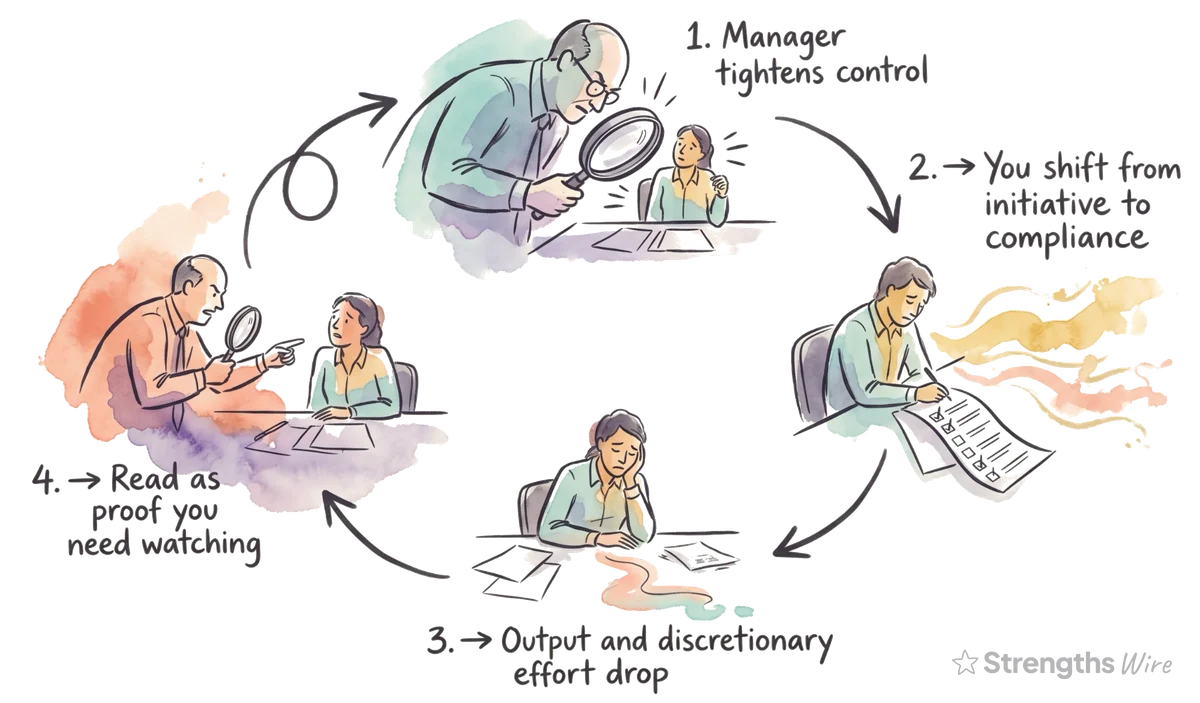
The managerial trap. The natural reaction is to watch more closely: more updates, more checking, more questions. That starts a loop. Their energy goes into proving they’re working, the extra effort stops, and the pulling back looks like proof they need watching (How micromanagement backfires: Gallup’s guide to micromanagement: how it starts, the signs, and why close monitoring tends to lower the very performance it is meant to protect. Source: Gallup (n.d.) The ultimate guide to micromanagers: signs, causes and solutions.). Tighten again and you speed up the exit.
The micromanagement loop
Ask about the past before the performance. Open with: “What part of this job used to give you energy, and when did that change?” Most people know straight away, and it’s rarely something a pay rise can fix.
Sort their week together. In your next one-on-one, go through their tasks and split them into the ones they’d happily start and the ones they have to force. The second pile shows you what the job stopped giving them.
Give them back the how. Agree the outcome and the limits, then let them decide how to get there. If a change took away work they loved, see whether you can hand some of it back. If they’ve outgrown the role, give them a harder problem with a clear goal (Stretch (challenging goals): Motivation grows when work sits just beyond what you can already do. Decades of goal-setting research find that specific, challenging goals lead to more effort, better performance and more satisfaction than easy goals or “do your best”. A role you’ve fully mastered stops supplying that challenge, and the drive it used to fuel goes quiet. Source: Locke, E.A. and Latham, G.P. (2002) ‘Building a practically useful theory of goal setting and task motivation: a 35-year odyssey’, American Psychologist, 57(9), pp. 705–717.) and a date.
Let them map their own values and strengths. Their answer will get you further than your guess. Point them at Week 1, free, then build your next conversation on what they find. For a whole team, the values sort works as a group exercise and gives everyone a shared language (Shared language: A standard vocabulary a team uses to describe how its people differ: what each person values, how each one processes information and risk. With it, behaviour stops getting filed under character (“she’s hostile”) and gets filed under wiring (“she leads with Deliberative; she stress-tests what she takes seriously”), which is how teams keep psychological safety while holding standards high. Source: de Wit, F.R.C., Greer, L.L. and Jehn, K.A. (2012) ‘The paradox of intragroup conflict: a meta-analysis’, Journal of Applied Psychology, 97(2), pp. 360–390. (on why the personal reading is so costly)) for how each person is wired, so talk to us if you’d like to run it.
Thirty years of coaching, consulting, and leading teams between them, and the same pattern in every room: the moment someone understands what drives them and where their energy comes from, they read the people around them better and put their energy where it counts. Work starts to feel like swimming with the current instead of against it.

Gallup-Certified Strengths Coach & Founder
Former Chief Product Officer who spent twenty years leading big teams at Australia’s largest companies, and found strengths and values work the single biggest unlock for growing herself and the people she led.

BSc(Hons), GradDip(Psyc), PhD
A strategy and human behaviour geek with a PhD: she brings a scientist’s rigour to why people do what they do, and has spent more than a decade helping organisations from scale-ups to Australia’s largest companies find the gaps in their strategy and their people, and close them.
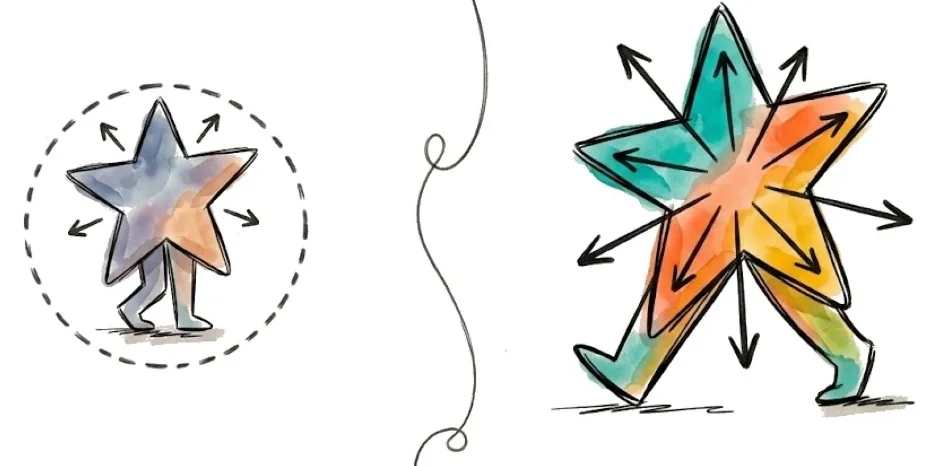
The world keeps trying to round you out. Fix the gaps, sand down the edges, become a well-balanced generalist. StrengthsWire starts from the opposite end: your edges are the point.
The goal is knowing what you’ve got and learning to aim it.
Developing a strength gives exponential growth. Fixing a weakness only gets you to average.
Misunderstanding what drives others causes conflict. Clarity on values changes how a team relates.
In the age of AI, understanding yourself and the people you work with is the skill that compounds.
If you can’t remember, that’s your answer, and it’s fixable. Start with your values. Week 1 is free, takes ten minutes a day on your phone, and shows you where the energy is going.
StrengthsWire is a self-understanding programme, not a treatment. If your exhaustion is severe or isn’t shifting, talk to your GP. Burnout and depression can overlap, and that’s a conversation worth having with a professional. And if the environment is abusive rather than misaligned, that deserves to be raised formally: your HR team or Fair Work is the right place to start.