Scenario 1
Your manager sends the client email back for a third revision.
Conflict
The boss who audits every email. The peer who picks holes in everything. The meeting that turns hostile by 9.30. Most of it is a collision you can’t see yet: what matters to you running into what matters to them.
We don’t hate the people we work with. We misunderstand them.
No credit card · 5–10 min lessons · On your phone
StrengthsWire is a five-week course that brings together the best of capability training and self-awareness, built on thirty years of coaching, consulting and leading teams. Week 1 is the values module, and it’s free.

Start by working out which kind you’ve got, because they need opposite treatments. Disagreement about the work (the deadline, the approach, the budget) is normal and often useful. Conflict between people is the one that does the damage (People conflict hurts teams; task conflict barely does: A meta-analysis of 116 studies on conflict in teams. Conflict between people (relationship conflict) was consistently bad for team performance, while disagreement about the task itself barely dented it. Source: de Wit, F.R.C., Greer, L.L. and Jehn, K.A. (2012) ‘The paradox of intragroup conflict: a meta-analysis’, Journal of Applied Psychology, 97(2), pp. 360–390.).
Here’s the part most advice skips. People-conflict usually starts life as work-conflict that got misread. She questioned your plan, and your brain filed it under “she doesn’t rate me”. He asked for a third revision, and you filed it under “control freak”. Once the behaviour has a character label on it, every new interaction gets read through that label, and the thing becomes personal.
So the useful first move in most workplace conflict is unglamorous: before you manage the person, check what you’ve assumed about them.
Week 1 walks you through moments like these and asks what you’ve assumed before you act on it.
It almost certainly isn’t about you. Us humans have a well-documented habit of blaming other people’s behaviour on their character while excusing our own with circumstances, the Fundamental Attribution Error (Fundamental Attribution Error: The human tendency to underestimate situational factors and overemphasise character when explaining other people’s behaviour, while doing the reverse for our own. At work it turns a colleague’s careful risk assessment into “they’re hostile” and a manager’s pressure from above into “they don’t trust me”. Named by psychologist Lee Ross in 1977. Source: Ross, L. (1977) ‘The intuitive psychologist and his shortcomings: distortions in the attribution process’, Advances in Experimental Social Psychology, 10, pp. 173–220.). So their scrutiny reads as distrust, the “control freak” label goes on, and every email after that gets read through it.
From inside their head, something different is happening. Usually it’s a strength running hot (Overused strength: A strength run with the dial stuck on high stops being an asset: Responsibility becomes taking over every ball in sight, Deliberative becomes analysis paralysis, scrutiny becomes a wall. Research on thousands of executives found leaders who overuse a strength are rated less effective than leaders with plain weaknesses. The fix is calibration, not removal. Source: Kaiser, R.B. and Kaplan, R.E. (2009) ‘Stop overdoing your strengths’, Harvard Business Review, 87(2), pp. 100–103.): a cautious, risk-reading talent that under enough pressure stops filtering and starts auditing. Every email becomes a place a mistake could cost them, and checking each one is how they settle that worry. Add a clash of values on top. They run on security and order, you run on autonomy and speed (Openness to Change vs Conservation: The most common axis of workplace conflict on the values circle. Openness to Change runs on self-direction and stimulation: autonomy, novelty, creative problem-solving. Conservation runs on security and conformity: stability, protocol, risk mitigation. What one side experiences as prudent standards, the other experiences as suffocating control; what one calls agility, the other calls recklessness. Both sides are defending something legitimate. Source: Schwartz, S.H. (2012) ‘An overview of the Schwartz theory of basic values’, Online Readings in Psychology and Culture, 2(1).). What they call quality control, your nervous system calls suffocation.
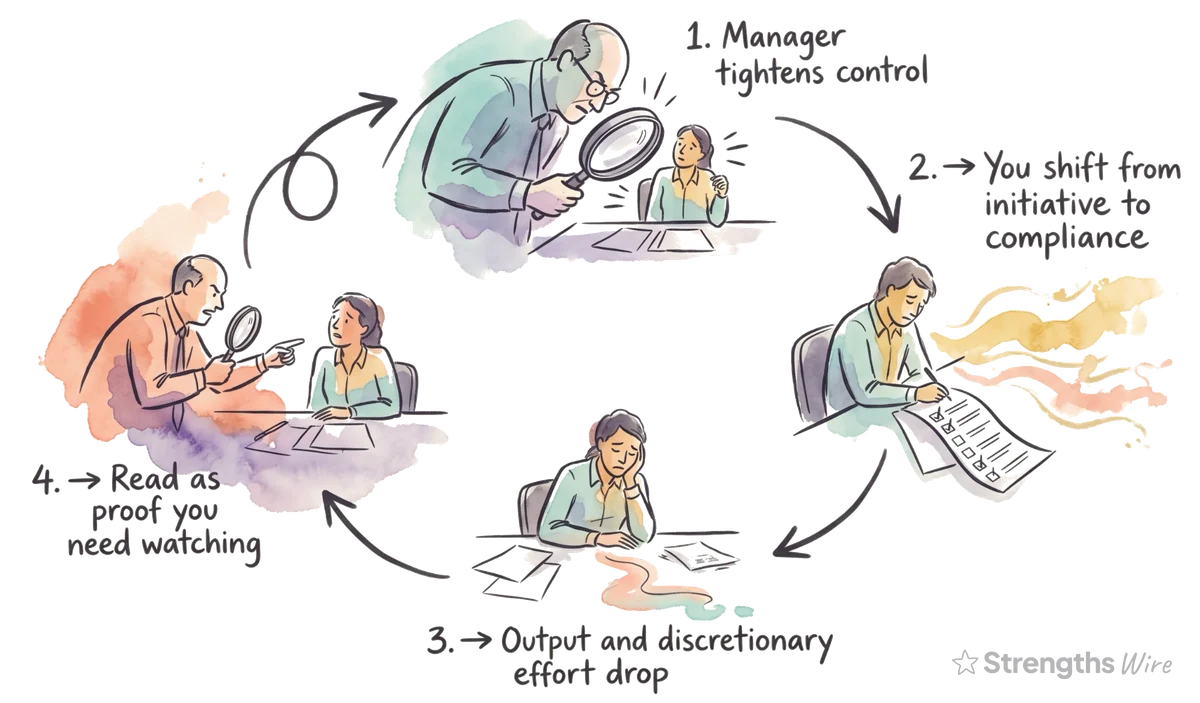
Then it loops. You spend your energy proving compliance instead of doing the work, your output slows, and the slowdown reads to them as proof you need watching (How micromanagement backfires: Gallup’s guide to micromanagement: how it starts, the signs, and why close monitoring tends to lower the very performance it is meant to protect. Source: Gallup (n.d.) The ultimate guide to micromanagers: signs, causes and solutions.). The way out is through what they’re protecting, not around it: name the risk before they go looking for it, and agree which messages genuinely need their sign-off.
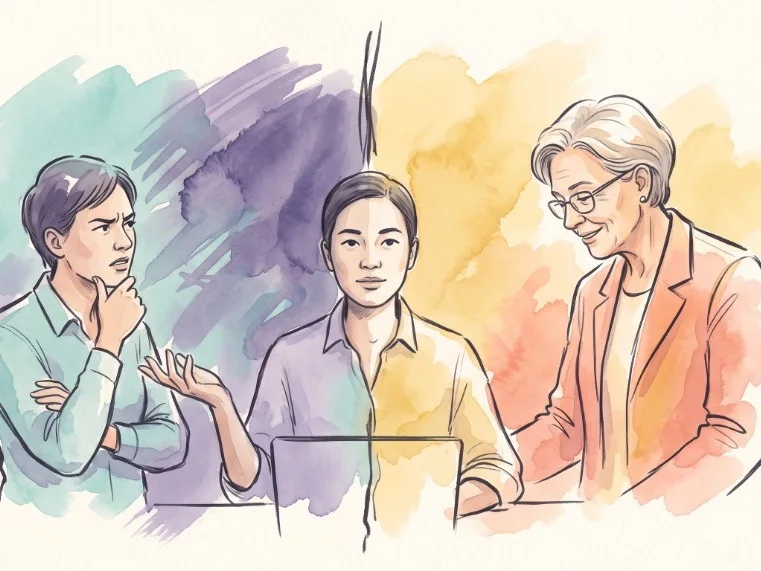
Jenny, Grace and the two lenses
Through the first lens, Grace is a micromanager. She reviews every line Jenny writes, and Jenny, arms crossed, reads it as distrust: Grace is hypercritical and set on squashing her freedom. Then Jenny maps what drives each of them. She runs on autonomy and speed. Grace runs on security and order, with a Deliberative talent for spotting what could go wrong. Through the second lens, the same reviews are due diligence, catching compliance and money problems before launch. Grace didn’t change. Jenny swapped a verdict on Grace’s character for a shared language, and the two of them started working as a pair.
Genuinely toxic teams exist, but they’re rarer than the label. What’s far more common is good-vs-good conflict: two people each defending something worth defending, and reading the other’s defence as an attack.
Research on human values (Schwartz’s theory of basic human values: A framework of universal human values, validated across more than 80 countries, arranged in a circle. Adjacent values (like Power and Achievement) are compatible and can be pursued together; values on opposite sides of the circle are in direct psychological conflict. The circle groups into four quadrants: Openness to Change, Conservation, Self-Enhancement and Self-Transcendence. Your top values are the “why” underneath your behaviour. Source: Schwartz, S.H. (2012) ‘An overview of the Schwartz theory of basic values’, Online Readings in Psychology and Culture, 2(1).) shows why. What people care about sits on a map where some values pull directly against others: freedom vs security, getting ahead vs looking after everyone. Put someone who runs on autonomy next to someone who runs on order and you get friction that looks exactly like a personality clash. Neither of them is wrong.
You can’t change someone’s personality, and you don’t need to. You can change what you assume their behaviour means.
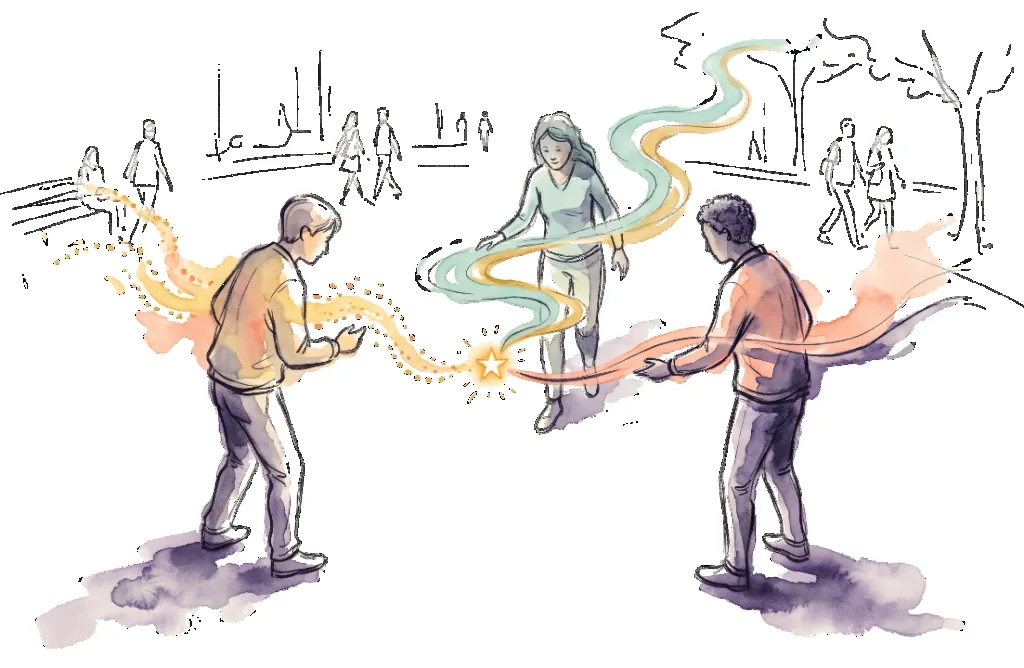
More of the working day happens in chat threads, tickets, and AI-drafted messages with the tone stripped out. A blunt two-line reply that would have landed fine in a corridor lands as hostility on a screen, and there’s no corridor later to repair it.
None of that creates a values clash. It amplifies one, by giving your brain more gaps to fill in and fewer cues to fill them in well.
Your values sit on a map of four quadrants, and so do your colleague's. Once you can see both, the behaviour that felt personal starts looking like a position on the map.
Week 1 is free and takes ten minutes a day on your phone.
Start Week 1 freeWeek 1 maps your own values first, because they’re the lens you’re misreading everyone else through.
Sort forty values and rank your top five, using a framework validated across 80+ countries. The trade-offs show you what you’re defending in those tense conversations, often without knowing it.
Your values sit on a map of four quadrants, and so do everyone else’s. Once you can place yourself, you can make a decent read on the boss or the colleague, and the behaviour that felt personal starts looking like a position on the map.
“You care about this landing safely, I care about it landing fast, how do we get both” is a very different Tuesday than another round of silent fuming. The final Week 1 lesson is on exactly this: decoding good-vs-good conflict at work and at home.
Week 1 is free, no credit card, no wall inside it. The full five weeks is $249 AUD if you want to keep going. Decide after Week 1.
Start Week 1 freeMost team trust exercises skip the hard part. People don't need to like each other more — they need to stop misreading each other. When a team has a shared language (Shared language: A standard vocabulary a team uses to describe how its people differ: what each person values, how each one processes information and risk. With it, behaviour stops getting filed under character (“she’s hostile”) and gets filed under wiring (“she leads with Deliberative; she stress-tests what she takes seriously”), which is how teams keep psychological safety while holding standards high. Source: de Wit, F.R.C., Greer, L.L. and Jehn, K.A. (2012) ‘The paradox of intragroup conflict: a meta-analysis’, Journal of Applied Psychology, 97(2), pp. 360–390. (on why the personal reading is so costly)) for what each person values and defends, behaviour stops getting filed under character and people start taking risks in front of each other again (Psychological safety: Amy Edmondson found that teams learn and perform better when people feel safe to speak up, ask questions and admit mistakes without being punished for it. Source: Edmondson, A. (1999) ‘Psychological safety and learning behavior in work teams’, Administrative Science Quarterly, 44(2), pp. 350–383.). The values sort works as a team exercise. If you want to run it with yours, talk to us.
Five we hear most, each answered on three layers: what you value, how you’re wired, and what you’ve probably misread. Open the one that’s yours.
When that thought crosses your mind, it signals a collision on three layers at once: a values clash, a mismatch in how you each claim work, and a gap in who-owns-what that let it happen.
The values layer. A colleague who presents your work as theirs, or as a vague “we”, is often running on Self-Enhancement values (Self-Enhancement vs Self-Transcendence: The other main axis of the values circle. Self-Enhancement runs on power and achievement: status, advancement, being seen to win. Self-Transcendence runs on benevolence and universalism: fairness, honesty, the welfare of the group. Workplaces overwhelmingly measure and reward the first; people anchored in the second can hit every target and feel nothing. Source: Schwartz, S.H. (2012) ‘An overview of the Schwartz theory of basic values’, Online Readings in Psychology and Culture, 2(1).): status, advancement, being seen to win. What it violates in you sits on the opposite side of the values map: fairness, honesty, the welfare of the group. That’s why it lands as a moral injury rather than a workplace annoyance, and why you’re still turning it over at 9pm. Your nervous system registers a breach of trust, not just a missed name-check.
The strengths layer. Quiet finishers, often leading with Executing themes like Achiever or Focus, assume competence is self-evident: do the work properly and the work will speak. Visible presenters, often leading with Influencing themes like Significance or Woo, assume nothing exists until it’s shown to the room. If you never claim your contribution out loud, you leave a visibility vacuum, and someone wired for the spotlight will fill it without ever deciding to rob you.
The misread. Before you settle on theft, know this: in classic experiments, people honestly recalled their own contributions to shared work more easily, and claimed more of the credit, than their collaborators gave them. Psychologists call it egocentric bias (Egocentric bias in shared work: In classic experiments, collaborators each honestly recalled their own contribution to joint work more easily than anyone else’s, and claimed more responsibility for the result than their partners gave them. Nobody is lying: your own effort is simply more available to your memory. It’s why two people can both sincerely believe the win was mostly theirs. Source: Ross, M. and Sicoly, F. (1979) ‘Egocentric biases in availability and attribution’, Journal of Personality and Social Psychology, 37(3), pp. 322–336.), and nobody is lying. He may genuinely remember a team win. You may be slightly overclaiming too. Our habit of explaining others’ behaviour by character rather than circumstance, the Fundamental Attribution Error (Fundamental Attribution Error: The human tendency to underestimate situational factors and overemphasise character when explaining other people’s behaviour, while doing the reverse for our own. At work it turns a colleague’s careful risk assessment into “they’re hostile” and a manager’s pressure from above into “they don’t trust me”. Named by psychologist Lee Ross in 1977. Source: Ross, L. (1977) ‘The intuitive psychologist and his shortcomings: distortions in the attribution process’, Advances in Experimental Social Psychology, 10, pp. 173–220.), does the rest, and in environments with no clear ownership, credit-capture becomes a shortcut for insecure people to look valuable.
Claim upstream, not after. Document as you go and pre-frame before the meeting: “I’ve finished the risk assessment and the modelling; Sam will present the summary.” Credit claimed in advance can’t be captured in the room.
Name the need without the accusation. “I completed that analysis and would like the execs to know my name and work. I’d like to present at the next one alongside you.” People who weren’t stealing almost always say yes.
Make attribution structural. Ask your project lead to name owners per deliverable at kickoff. Clear ownership makes credit-capture impossible without it being visible.
Work out why this one burns. The sting is a signal about your own values: recognition for your craft is clearly one of them. Sort your values and see your top five in Week 1, free, so the next time something at work burns you know exactly which wire it touched.
That thought signals a breakdown across three layers: an overused strength in your manager, a values conflict between control and autonomy, and a feedback loop that makes both worse.
The strengths layer. The takeover can come from several different wirings, and the fix differs with each. A manager leading with Responsibility can’t bear a dropped ball, so they pick up every ball in sight. One leading with Maximizer can’t leave good alone: they take the work back to polish it to their own standard. And one leading with Developer or Empathy may honestly believe that jumping into the weeds is helping you, protecting you from stress, never noticing that the “help” is hollowing out your job and stunting your growth. All three are strengths with the dial stuck on high. Research on executives found leaders who overuse a strength (Overused strength: A strength run with the dial stuck on high stops being an asset: Responsibility becomes taking over every ball in sight, Deliberative becomes analysis paralysis, scrutiny becomes a wall. Research on thousands of executives found leaders who overuse a strength are rated less effective than leaders with plain weaknesses. The fix is calibration, not removal. Source: Kaiser, R.B. and Kaplan, R.E. (2009) ‘Stop overdoing your strengths’, Harvard Business Review, 87(2), pp. 100–103.) are rated less effective than leaders with plain weaknesses.
The values layer. The clash usually runs along the control–freedom axis (Openness to Change vs Conservation: The most common axis of workplace conflict on the values circle. Openness to Change runs on self-direction and stimulation: autonomy, novelty, creative problem-solving. Conservation runs on security and conformity: stability, protocol, risk mitigation. What one side experiences as prudent standards, the other experiences as suffocating control; what one calls agility, the other calls recklessness. Both sides are defending something legitimate. Source: Schwartz, S.H. (2012) ‘An overview of the Schwartz theory of basic values’, Online Readings in Psychology and Culture, 2(1).) of the values map. Your manager is defending Conservation values: security, risk mitigation, nothing breaking on their watch. What it starves in you is Self-Direction: agency, creative problem-solving, the need to make your own calls. Autonomy is one of the three basic psychological needs (Self-Determination Theory: The leading research framework on human motivation, from psychologists Richard Ryan and Edward Deci. Wellbeing and intrinsic drive depend on three basic psychological needs being met: autonomy (a say in how you work), competence (feeling capable) and relatedness (connection to others). Thwart them, above all autonomy, and motivation collapses regardless of pay or title. Source: Ryan, R.M. and Deci, E.L. (2000) ‘Self-determination theory and the facilitation of intrinsic motivation, social development, and well-being’, American Psychologist, 55(1), pp. 68–78.), and roles that thwart it drain motivation and breed cynicism fast. What your manager sees as prudent oversight, your nervous system experiences as suffocation. Both readings are real.
The structural trap. A loop then takes hold (How micromanagement backfires: Gallup’s guide to micromanagement: how it starts, the signs, and why close monitoring tends to lower the very performance it is meant to protect. Source: Gallup (n.d.) The ultimate guide to micromanagers: signs, causes and solutions.): the manager takes over, you shift from initiative to compliance, your disengagement reads to them as lack of drive, which justifies taking over more. Observing your pull-back, they commit the standard attribution error (Fundamental Attribution Error: The human tendency to underestimate situational factors and overemphasise character when explaining other people’s behaviour, while doing the reverse for our own. At work it turns a colleague’s careful risk assessment into “they’re hostile” and a manager’s pressure from above into “they don’t trust me”. Named by psychologist Lee Ross in 1977. Source: Ross, L. (1977) ‘The intuitive psychologist and his shortcomings: distortions in the attribution process’, Advances in Experimental Social Psychology, 10, pp. 173–220.), assuming character where there’s circumstance, and the loop tightens.
The micromanagement loop
Pre-frame risk upstream. Soothe their risk engine before they feel compelled to intervene: “Here’s the draft; I’ve identified bottleneck X and built contingency Y to protect the timeline.”
Define “done” and decision boundaries upfront. Before a project starts, negotiate what success looks like and where your authority begins and ends: “Which decisions do you want to see before they’re made, and which are mine?”
Have the outcome-based conversation. “I want you to have total confidence in my work while freeing your bandwidth for strategy. What checkpoints do you need so you’re comfortable letting me own this end-to-end?”
Know what the takeover starves in you. If losing ownership guts you more than it would the person at the next desk, autonomy is high on your values map. Name your top five values in Week 1, free, so you can negotiate for the one that matters instead of fighting about everything.
That thought reveals a collision across three layers: a clash in what the meeting is for, two very different kinds of wiring, and a room full of bystanders with no shared rules.
The values layer. Being talked over, and met with silence from your peers, violates what matters to you (The circle of human values: Shalom Schwartz’s research, tested across dozens of countries, finds that values sit in a circle: some sit side by side, and others pull against each other, like freedom and security. Source: Schwartz, S.H. (2012) ‘An overview of the Schwartz theory of basic values’, Online Readings in Psychology and Culture, 2(1).): equal voice, mutual respect, the basic order of turn-taking. For the interrupter, the drive is usually status or stimulation: demonstrating competence by controlling the airtime, or an urge to move fast that overrides conversational manners. The silence of colleagues feels like passive approval of it, which is why the moment stings twice.
The strengths layer. Interrupters are usually out-loud processors, often leading with themes like Activator or Command: they don’t know what they think until they hear themselves say it, they feel a real urge toward immediate action, and they read your pause as empty space that needs filling. If you lead with themes like Deliberative, Analytical or Input, your brain runs the slower, structured route: evaluate the risk, build the logic, complete the thought, then speak. When you pause to frame your point, the fast brain jumps into the gap. The format rewards their wiring and taxes yours, and nobody designed it that way on purpose.
The misread, twice over. It’s natural to assume hostility, and natural to read the room’s silence as agreement. Both are usually wrong, and the first is the Fundamental Attribution Error (Fundamental Attribution Error: The human tendency to underestimate situational factors and overemphasise character when explaining other people’s behaviour, while doing the reverse for our own. At work it turns a colleague’s careful risk assessment into “they’re hostile” and a manager’s pressure from above into “they don’t trust me”. Named by psychologist Lee Ross in 1977. Source: Ross, L. (1977) ‘The intuitive psychologist and his shortcomings: distortions in the attribution process’, Advances in Experimental Social Psychology, 10, pp. 173–220.) doing its usual work. The interrupter would mostly be mortified to learn you’d been waiting for a gap. And your colleagues aren’t siding with them; they’re frozen, unwilling to trigger a public confrontation in a team with no explicit meeting norms. Without shared rules, or a shared language (Shared language: A standard vocabulary a team uses to describe how its people differ: what each person values, how each one processes information and risk. With it, behaviour stops getting filed under character (“she’s hostile”) and gets filed under wiring (“she leads with Deliberative; she stress-tests what she takes seriously”), which is how teams keep psychological safety while holding standards high. Source: de Wit, F.R.C., Greer, L.L. and Jehn, K.A. (2012) ‘The paradox of intragroup conflict: a meta-analysis’, Journal of Applied Psychology, 97(2), pp. 360–390. (on why the personal reading is so costly)) for how each person in the room processes, discussion defaults to whoever speaks loudest and fastest.
Pre-frame your contribution. Set the boundary marker before you start: “I’ve got a two-part idea; give me sixty seconds to lay out both parts before we discuss.” A declared slot is much harder to talk over than a pause.
Reclaim the floor in real time, without heat. “Hold on, I wasn’t finished making that point – let me wrap it up so the team has the full context.”
Fix the format, not the person. Ask whoever chairs the meeting to go around the table on key calls, or to appoint a facilitator. It helps every quiet processor in the room without naming anyone.
Learn your own processing style properly. Whether you compose first and speak second is wiring, not weakness, and knowing it lets you design around it instead of resenting rooms built for the other kind. Start that map with your values in Week 1, free.
That thought signals your feedback landed somewhere you didn’t aim it: on who they are instead of what they did.
The values layer. The sting is sharpest when feedback touches the value a person builds their identity on, the one near the top of their values map (Schwartz’s theory of basic human values: A framework of universal human values, validated across more than 80 countries, arranged in a circle. Adjacent values (like Power and Achievement) are compatible and can be pursued together; values on opposite sides of the circle are in direct psychological conflict. The circle groups into four quadrants: Openness to Change, Conservation, Self-Enhancement and Self-Transcendence. Your top values are the “why” underneath your behaviour. Source: Schwartz, S.H. (2012) ‘An overview of the Schwartz theory of basic values’, Online Readings in Psychology and Culture, 2(1).). Tell a detail person about three errors and they don’t hear “three errors”; they hear “your craft is slipping”. The content was about a document. The impact was about their worth, and those are different conversations.
The strengths layer. People take the most pride in their dominant strength, which makes it the most sensitive place to receive criticism. Point out errors to someone leading with Discipline or Consistency and you’ve touched the exact thing they build their identity on: being the person who doesn’t make them. The more the feedback touches someone’s signature theme, the more carefully it needs framing, because you’re not correcting a task, you’re handling the thing they’d put on their headstone.
The misread. The awkwardness isn’t a grudge. A landmark meta-analysis of over 600 studies found more than a third of feedback attempts made performance worse, and the mechanism is attention shifting from the task to the self (Feedback that lands on the self: A meta-analysis of over 600 studies found feedback improves performance on average, but more than a third of attempts make it worse. The deciding factor is where attention goes: feedback that stays on the task works; feedback that pulls attention to the person (their identity, their worth) triggers defence, embarrassment and avoidance instead of learning. Source: Kluger, A.N. and DeNisi, A. (1996) ‘The effects of feedback interventions on performance: a historical review, a meta-analysis, and a preliminary feedback intervention theory’, Psychological Bulletin, 119(2), pp. 254–284.): defence, embarrassment, avoidance. They’re not angry at you. They’re managing a feeling, and avoiding you is how.
Reopen with the value named first. “I brought that to you because you’re the most careful person on this team, and I’d want you doing the same for me.” It hands their reputation back.
Re-anchor to the task. Make the next conversation about the document, the process, the fix: concrete and future-facing. Task-focused feedback is the kind that works.
Don’t wait it out. Awkwardness compounds through avoidance. One warm, ordinary interaction usually resets it within a day.
Learn the tender spots, starting with yours. Feedback lands on values, so the same sentence is neutral to one person and a wound to another. Map your own values in Week 1, free, which is how you learn to spot everyone else’s.
Completely normal, and one of the most common warning signs in workplace psychology. Meeting dread isn’t weakness or simple dislike; it’s a biological and psychological signal, and beneath it sits a specific collision: a values clash, a cognitive speed mismatch, and your nervous system registering threat.
The values layer. The most common trigger runs along the Openness to Change versus Conservation (Openness to Change vs Conservation: The most common axis of workplace conflict on the values circle. Openness to Change runs on self-direction and stimulation: autonomy, novelty, creative problem-solving. Conservation runs on security and conformity: stability, protocol, risk mitigation. What one side experiences as prudent standards, the other experiences as suffocating control; what one calls agility, the other calls recklessness. Both sides are defending something legitimate. Source: Schwartz, S.H. (2012) ‘An overview of the Schwartz theory of basic values’, Online Readings in Psychology and Culture, 2(1).) axis. If your drivers are self-direction and stimulation (autonomy, fast iteration, novelty), meetings with a colleague driven by security and conformity (risk mitigation, protocol, thorough vetting) feel like driving with the handbrake on. What they call prudent due diligence, you experience as suffocating control; what you call agile problem-solving, they experience as reckless risk. You’re optimising for different definitions of success, so every agenda item becomes a tug-of-war.
The strengths layer. Underneath the values clash is a processing-speed mismatch. If you run fast-moving themes like Activator, Command or Ideation, you thrive on real-time thinking and quick decisions. A colleague with dominant Deliberative or Analytical talents runs the slow, careful route: scanning for landmines, stress-testing assumptions, calculating risk before speaking. Run uncalibrated (Overused strength: A strength run with the dial stuck on high stops being an asset: Responsibility becomes taking over every ball in sight, Deliberative becomes analysis paralysis, scrutiny becomes a wall. Research on thousands of executives found leaders who overuse a strength are rated less effective than leaders with plain weaknesses. The fix is calibration, not removal. Source: Kaiser, R.B. and Kaplan, R.E. (2009) ‘Stop overdoing your strengths’, Harvard Business Review, 87(2), pp. 100–103.), their barrage of probing questions feels less like collaboration and more like an interrogation. (It runs the other way too: if you’re the careful one, their pace feels like being dragged behind a car.)
The body’s part. When you anticipate a room where your autonomy is threatened or your ideas get systematically picked apart, your nervous system fires the same stress response (Anticipatory stress (the Sunday response): The body’s stress system responds to a demanding week before it starts: studies of the cortisol awakening response show stress hormones rise more steeply on workday mornings than weekends, with the biggest gap in people carrying chronic work overload and worry. Sunday dread is a measurable forecast, not a personal weakness. Source: Schlotz, W., Hellhammer, J., Schulz, P. and Stone, A.A. (2004) ‘Perceived work overload and chronic worrying predict weekend–weekday differences in the cortisol awakening response’, Psychosomatic Medicine, 66(2), pp. 207–214.) as physical danger: tight shoulders, shallow breathing, dread arriving hours before the invite. Your brain then completes the attribution error (Fundamental Attribution Error: The human tendency to underestimate situational factors and overemphasise character when explaining other people’s behaviour, while doing the reverse for our own. At work it turns a colleague’s careful risk assessment into “they’re hostile” and a manager’s pressure from above into “they don’t trust me”. Named by psychologist Lee Ross in 1977. Source: Ross, L. (1977) ‘The intuitive psychologist and his shortcomings: distortions in the attribution process’, Advances in Experimental Social Psychology, 10, pp. 173–220.) by filing the colleague under “toxic”, when what you usually have is two professionals with opposed operating systems and no shared language (Shared language: A standard vocabulary a team uses to describe how its people differ: what each person values, how each one processes information and risk. With it, behaviour stops getting filed under character (“she’s hostile”) and gets filed under wiring (“she leads with Deliberative; she stress-tests what she takes seriously”), which is how teams keep psychological safety while holding standards high. Source: de Wit, F.R.C., Greer, L.L. and Jehn, K.A. (2012) ‘The paradox of intragroup conflict: a meta-analysis’, Journal of Applied Psychology, 97(2), pp. 360–390. (on why the personal reading is so costly)). Relationship conflict of this kind is roughly sixteen times more damaging to team performance (People conflict hurts teams; task conflict barely does: A meta-analysis of 116 studies on conflict in teams. Conflict between people (relationship conflict) was consistently bad for team performance, while disagreement about the task itself barely dented it. Source: de Wit, F.R.C., Greer, L.L. and Jehn, K.A. (2012) ‘The paradox of intragroup conflict: a meta-analysis’, Journal of Applied Psychology, 97(2), pp. 360–390.) than disagreement about the work, so it’s worth defusing rather than enduring.
Depersonalise the style before you walk in. “They’re not attacking me; their brain audits risk, mine explores possibilities.” Wiring, not war.
Pre-frame the ground rules. “I’ll share a five-minute high-level proposal. Hold the risk questions until the end so we can cover the core concept first.”
Give careful processors their time in advance. Send the brief 24 hours early. When Deliberative or Analytical wiring gets to evaluate privately, the need to challenge you publicly drops sharply.
Invite the scrutiny on your terms. “What are the top two landmines you see in this plan that we should design around?” Their strength becomes your risk review instead of your dread.
Map your own operating system. The dread is partly a values report: it fires where what you’re optimising for is being blocked. See what that is in Week 1, free.
Thirty years of coaching, consulting, and leading teams between them, and the same pattern in every room: the moment someone understands what drives them and where their energy comes from, they read the people around them better and put their energy where it counts. Work starts to feel like swimming with the current instead of against it.

Gallup-Certified Strengths Coach & Founder
Former Chief Product Officer who spent twenty years leading big teams at Australia’s largest companies, and found strengths and values work the single biggest unlock for growing herself and the people she led.

BSc(Hons), GradDip(Psyc), PhD
A strategy and human behaviour geek with a PhD: she brings a scientist’s rigour to why people do what they do, and has spent more than a decade helping organisations from scale-ups to Australia’s largest companies find the gaps in their strategy and their people, and close them.
The world keeps trying to round you out. Fix the gaps, sand down the edges, become a well-balanced generalist. StrengthsWire starts from the opposite end: your edges are the point.
The goal is knowing what you’ve got and learning to aim it.
Developing a strength gives exponential growth. Fixing a weakness only gets you to average.
Misunderstanding what drives others causes conflict. Clarity on values changes how a team relates.
In the age of AI, understanding yourself and the people you work with is the skill that compounds.
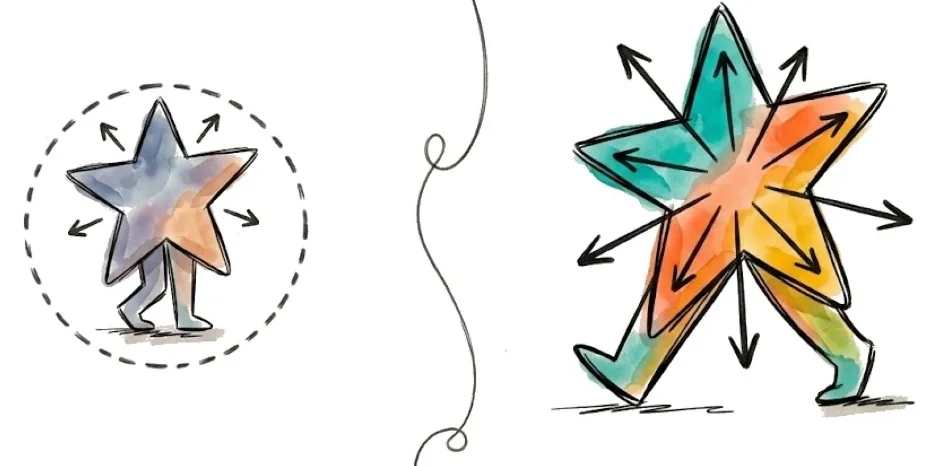
Think about the person who’s on your mind right now. Then find out what your own fuel is. Week 1 is free, ten minutes a day on your phone.
A values clash explains most friction. It doesn’t excuse bullying or harassment. If that’s what you’re dealing with, it deserves to be raised formally, and your HR team or Fair Work is the right place to start.